FLOP Airdrop Requirements and How to Join|Arthur Hayes's New L1
- Duration
- 2026/11/24 ~
- Task
- Supported Chains
- Category
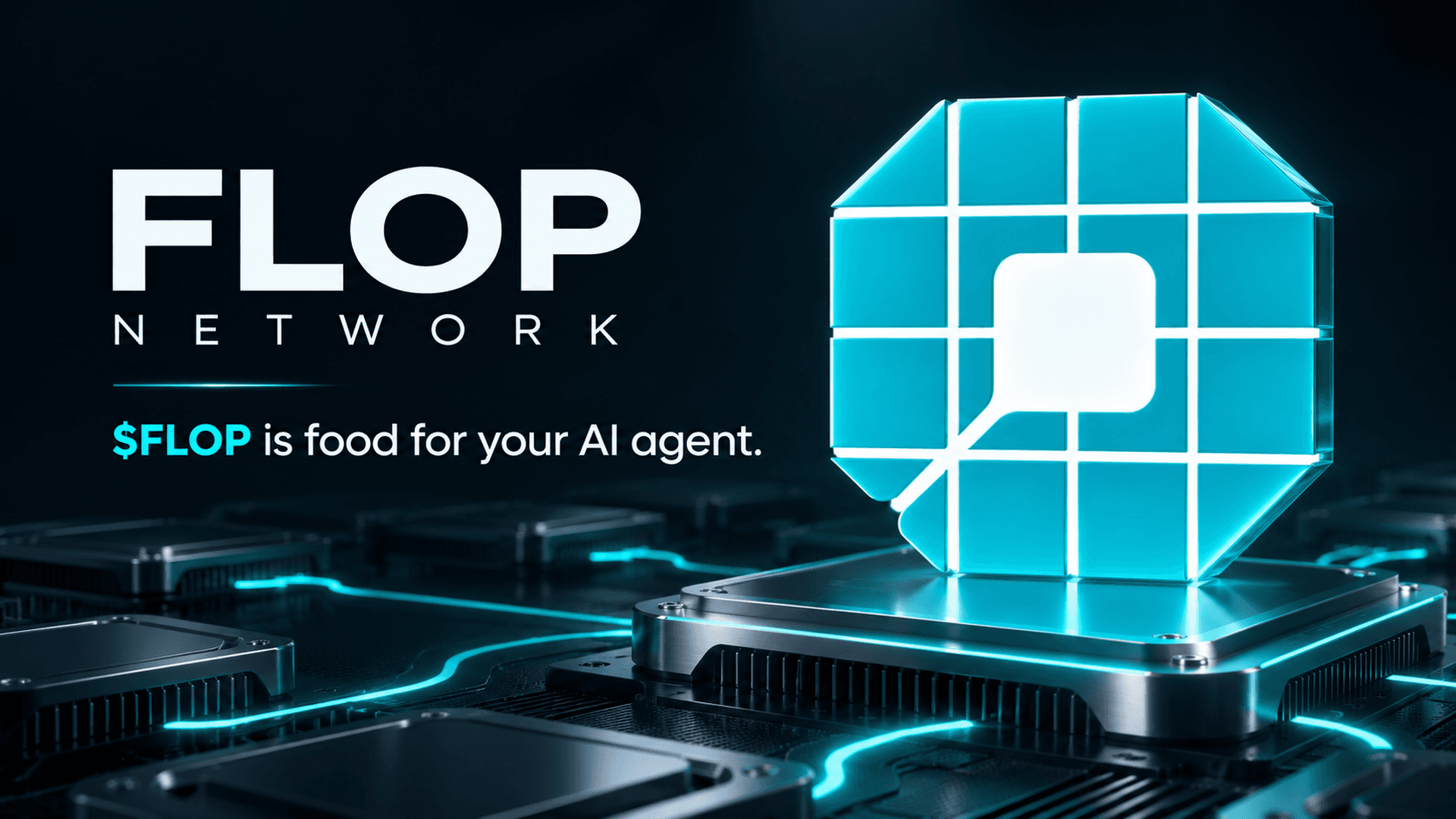
Table of Contents
FLOP Network is a purpose-built blockchain (L1) where AI agents pay for AI inference in FLOP, and GPU owners take on that inference work to earn rewards. Arthur Hayes, co-founder of BitMEX, serves as CEO, and the project says it will launch the token with no presale and no allocation to VCs. FLOP has not been issued yet, and the public testnet that determines the airdrop allocation is scheduled to start on November 24, 2026.
What Is FLOP Network|An L1 for Paying for AI Inference
The FLOP chain handles inference orders and the payments for them. An agent places an order specifying the model to use, the maximum time it is willing to wait, the fee it will pay, and so on. GPU owners called miners execute the order and receive payment in FLOP.
| Item | Details |
|---|---|
| Chain | Substrate-based L1 (not EVM-compatible) |
| Block time | 1 second on average |
| Token | FLOP (not yet issued) |
| Funding | Investment from Maelstrom (Hayes's family office) only |
The chain has no general-purpose smart contracts; its role is narrowed to buying, selling and settling inference.
Image: Screenshot of the official FLOP website (captured November 18, 2026)
The team positions FLOP as an alternative to inference APIs such as OpenRouter for agents that buy inference. For GPU owners, it is an alternative to renting out GPU time on Akash and similar services or to mining on Bittensor. We also cover other projects dealing with AI compute in our articles on 0G and Compute Labs.
Led by Arthur Hayes with His Own Money
Hayes is CEO of the operating company, FLOP Labs. The CTO is Sergey Vidyuk, who led technology at BitMEX, and the CSO is Shu Duan, formerly of Deutsche Bank. Funding comes solely from Maelstrom, which Hayes owns outright; there has been no outside fundraising, and the company is said to have more than two years of runway. While there are no tokens to hand out to investors, development funding depends on the wealth of Hayes alone.
Hayes announced his return from retirement on August 18, 2026, writing that he wants to let humans and AI agents trade at a single global price per unit of compute. During his BitMEX days he was charged with violating the US Bank Secrecy Act, pleaded guilty in 2022 and paid a $10 million fine, and received a pardon from President Trump in March 2025.
How FLOP Works|Inference Verification and Fee Flow
Because the contents of an inference cannot be seen from outside, the core of the chain's design is how to confirm that a miner really ran the specified model.
Miners submit a proof built from intermediate computation values (TOPLOC) along with a record of the exchange co-signed with the agent. Submitted proofs can be challenged for about 7 days. Triggered by random sampling or a collateral-backed challenge, part of the work is re-executed and compared, and if cheating is found, the miner's entire stake is slashed.
Filing a challenge requires 100 FLOP in collateral. Rather than recomputing everything every time, the system spot-checks and takes everything from anyone caught, making cheating not worth the risk.
Of the inference fees paid, 85% goes to miners and 15% to validators, with no cut for FLOP Labs or the foundation. OpenRouter charges a 5.5% fee (minimum $0.80) when you buy credits. FLOP is designed to remove that kind of intermediary cut. As differences from competitors, the team points out that Bittensor scores by voting and Akash and similar services merely rent out GPU time, so neither verifies the inference itself.
FLOP Airdrop and Tokenomics
The FLOP airdrop splits the 4.4 billion FLOP to be distributed at mainnet launch (genesis) by role on the testnet.
| Role | Pool | How allocation is decided | Unlock after receipt |
|---|---|---|---|
| Miners | 1.2 billion FLOP | Pro rata by verified compute provided on the testnet | 25% usable immediately; the rest unlocks in amounts equal to what is earned on mainnet |
| Agents | 1.2 billion FLOP | Pro rata by compute purchased through settled inference | 1 FLOP unlocks for every 3 FLOP spent on inference |
| Validators | 1.2 billion FLOP | 1.2 million FLOP each for up to 1,000 top-ranked seats | Unlocks gradually over about 10 years |
| Ecosystem reserve | 800 million FLOP | Programs for creators, referrals and developers | ― |
The miner pool is allocated only by verified compute, and job counts, days online and token holdings are not counted. The amount of work actually processed matters more than adding machines or running them longer. Because the agent pool does not unlock unless it is spent on inference, buying inference is the starting point.
Image: From the official FLOP website (retrieved November 18, 2026)
After that, the block reward is 96 FLOP per block, 75% of which goes to miners. Issuance halves five times, every 730 days, and then continues at 3 FLOP per block, so there is no cap on supply. Total supply at the end of year 10 is about 18.09 billion FLOP, of which the airdrop is 24.3% and miner block rewards are 48.6%. Separately, FLOP Labs and the FLOP Foundation each issue 8 FLOP per block, accounting for 10.8% of supply in year 10. There are no pre-allocations to the team or investors, and all figures are drafts presented by the team.
The mainnet launch date, when distribution takes place, has not been set; the official website only says Q1 2027.
How to Join the FLOP Testnet|Getting Started by Role
Only work done after the public testnet begins counts toward allocation. The public testnet is targeted to start on November 24, 2026, and will run for up to about 90 days. The original target was November 3, but it did not start that day, and on November 13 Hayes posted on X naming November 24 as the start date.
The project does not state which countries may participate and leaves the decision to participants themselves. There is nothing specific about participation from Japan.
devnet vs. the FLOP Testnet
The development network anyone can use (devnet) carries no rewards and no airdrop weight. The testnet application form is an optional contact registration; there is no approval or rejection, no whitelist and no participant cap.
The devnet chain is running, and as of November 18 the block height was about 4.03 million. However, only 0–3 models are listed on the public gateway, so as an inference market it is still small.
GPUs and Costs Needed for FLOP Mining
Miners need a GPU with at least 16GB of VRAM per card (recommended) and an environment where Docker can use the GPU. The verified configuration is an NVIDIA A40.
A miner's stake is a base of 10,000 FLOP plus collateral based on compute capacity. During the testnet, however, the network covers it, so the out-of-pocket cost is the GPU. By the team's estimate, a rented H100 costs about $1,800 per month, or roughly $5,400–7,500 for the approximately three-month testnet.
There is also a reward estimate of about $15,000 per card per month, but it rests on assumptions of a $100 million market cap and about 1,200 H100-equivalents across the whole network.
Image: Screenshot of the FLOP GPU market monitor (captured November 18, 2026)
If you rent GPUs, you can check going rates on the team's GPU market monitor. On November 18, the average rental price was about $1.34 per hour in H100 equivalents.
No GPU? Join as an Agent or Validator
Even without a GPU, you can take part as an agent, the side that buys inference. An agent creates a DID and a wallet and buys inference with test tokens received from the faucet. Use Polkadot.js, Talisman or SubWallet as your wallet; EVM wallets such as MetaMask cannot sign.
Image: Screenshot of the FLOP Faucet (captured November 18, 2026)
The devnet faucet offers two options: receive 25 FLOP instantly, or verify your identity to receive 500–2,000 FLOP.
Validators do not need a GPU, but server-grade hardware such as 64GB of memory is the guideline. The 1.2 million FLOP stake is covered by the network during the testnet. There are up to 1,000 mainnet seats, selected based on testnet performance.
Risks Before Joining FLOP|Fake Tokens and Unimplemented Rules
For a project with no token yet, buying a fake and having the announced distribution terms not carried out as stated are the most likely paths to losses.
| Caution | Details |
|---|---|
| Fake token | "Flop Labs (FLOP)" on Solana (market cap about $37,000) is unrelated to the official project |
| Fake communities | There is no official Discord, Telegram, Reddit or Medium |
| Outdated figures | The roughly 2.48 billion FLOP genesis figure reported in September 2026 is old; it is now 4.4 billion FLOP |
Although the distribution terms are set, the chain-side implementation has not caught up. By the team's own account, the current chain processes every grant as an even unlock over 90 days, and the role-specific unlock rules and validator seat rules are approved but not yet built in.
Application numbers also should not be taken at face value. Applications through September 10, 2026 totaled 18,125, but the team notes they are neither a count of GPUs nor a commitment to participate. Because the miner pool is divided by compute processed, the share per card will vary greatly depending on how much GPU capacity the testnet attracts.
GPU costs are paid up front in dollars, while what you receive is FLOP, which has no price yet, and most of it unlocks according to activity after mainnet launch.
Summary
FLOP Network is an L1 that settles the buying and selling of inference with verification, and its 4.4 billion FLOP airdrop will be distributed according to work on the testnet scheduled to start on November 24. GPU owners can take part as miners, but allocation is decided by verified compute, and costs go out first in dollars. Because work on devnet does not count toward allocation, it is not too late to start participating after confirming that the testnet has launched.
Sources
- Official FLOP website (2026)
- Official FLOP website: Overview (2026)
- Official FLOP website: Airdrop page (2026)
- Official FLOP website: Testnet (2026)
- Official FLOP website: Tokenomics (2026)
- Official FLOP website: Official verification page (2026)
- FLOP Docs "Technology and Chain" (2026)
- FLOP Docs "Team and Company" (2026)
- FLOP Docs "Competitive Landscape" (2026)
- FLOP Docs "Verification Stack" (2026)
- FLOP Docs "Agent Integration" (2026)
- FLOP Docs "Tokenomics and Supply" (2026)
- FLOP Docs "Testnet Conversion" (2026)
- FLOP Docs "Testnet and Timeline" (2026)
- FLOP Docs "Agent Onboarding" (2026)
- FLOP Docs "Staking and Slashing" (2026)
- FLOP Docs "Miner and Validator Economics" (2026)
- FLOP Faucet (2026)
- FLOP GPU market monitor (2026)
- FLOP devnet RPC (2026)
- FLOP Gateway API (2026)
- Arthur Hayes "The Book of Genesis" (2026)
- Arthur Hayes official X (2026)
- crypto.news (2026)
- crypto.news (2026)
- The Block (2025)
- OpenRouter "FAQ" (2026)
- Solana Compass (2026)
Disclaimer
- ・This article is created for informational purposes only and should not be used to solicit the sale, purchase, or underwriting of cryptocurrencies, securities, or other financial products, nor should it be considered an invitation to engage in such transactions, or constitute financial or investment advice.
- ・The information and opinions in this article are obtained from sources that we believe to be reliable, but we do not guarantee their accuracy, completeness, suitability, timeliness, or truthfulness.
- ・We, the authors, and all related parties are not responsible for any damage or loss caused by or related to the information published in this article. Cryptocurrencies involve hacking and other risks, so please conduct thorough research before using them.
Supervised by

Shingo Arai
CEO, Rokubunnoni Inc.
After completing a Master's degree in Management Engineering at Tokyo University of Science in 2013, Shingo Arai worked as an engineer, data scientist, and data analyst at multiple companies in the web, app, and advertising industries. He entered the cryptocurrency and blockchain space around 2017, founded Rokubunnoni Inc. in January 2018, and launched Crypto Times — a blockchain-focused media outlet — in February 2018. With approximately 9 years in the industry, his expertise spans DeFi, L1/L2 protocols, tokenomics, ZKP, and domestic/international regulatory trends. He actively conducts on-chain asset management and research. He has authored and supervised hundreds of articles, spoken at conferences in Japan and abroad, served as a DeFi investment seminar instructor, and operated KOL ambassador programs.
Recommended Articles




Table of Contents