What Is RWA (Real World Assets)? | How It Works, Key Projects, and Japan's Market
August 5, 2026
~24 min
RWA (Real World Assets) is a crypto sector that tokenizes rights to real-world assets such as U.S. Treasuries and real estate. See the measured 2026 market size, the leading projects, how RWAs differ from Japan's security tokens, and where investors in Japan can access them.
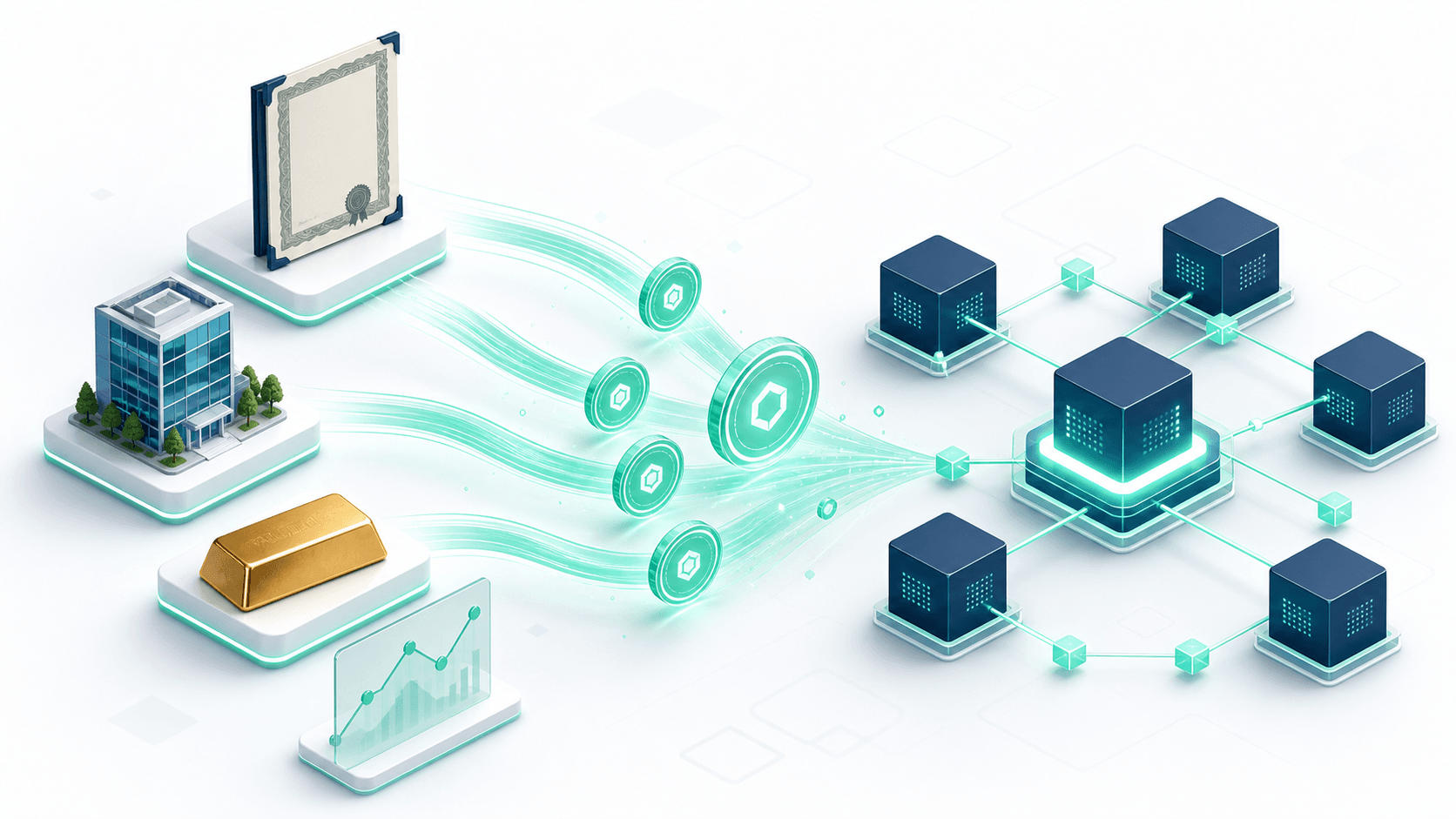
Table of Contents
 300
300Tokenizing real-world assets such as U.S. Treasuries and real estate into blockchain tokens — "RWA (Real World Assets)" — has become a central theme of the crypto market. BlackRock, the world's largest asset manager, runs a tokenized Treasury fund, and a major exchange now accepts tokenized stocks as loan collateral.
Meanwhile, Japanese-language search results mix forecasts like "$16 trillion by 2030" with discussions of security tokens regulated under the Financial Instruments and Exchange Act, all under the same word: RWA. What is actually being tokenized, how much of the numbers are measured rather than projected, and where individuals in Japan can access them — these three points are the axes for understanding RWA.
What RWA (Real World Assets) Means
RWA (Real World Assets) refers to rights to real-world assets represented as tokens on a blockchain. The underlying assets are anything held off-chain — U.S. Treasuries, real estate, gold, equities, corporate lending — and holding the token is tied to a legal and economic claim on that asset.
There is no single originator or standard behind the term. Around 2020, MakerDAO, which runs the stablecoin DAI, began debating the use of real-world assets as collateral.
In April 2021 it teamed up with Centrifuge to finance the first real-world loan on-chain, and the term settled in as DeFi vocabulary around that time.
rwa.xyz, the de facto standard for market data in this field, counts stablecoins separately from RWAs proper, so the market size shifts by an order of magnitude depending on which you include.
What Tokenization Actually Changes
Three things change: trading hours, minimum size, and settlement. Equities and Treasuries once bound by market hours and minimum investment amounts can be traded 24/7 in small denominations, with settlement completed on-chain.
The other big shift is reuse as collateral. On July 31, 2026, Bybit began accepting tokenized Nvidia and Apple shares as loan collateral, and the practice of putting real-world assets in the same collateral bucket as crypto is now spreading to major exchanges.
How Big the RWA Market Is Right Now
On-chain RWAs total roughly $37.2 billion across roughly 1.56 million holders, and the number of holders has grown about 50% in the past 30 days alone. The momentum here is in the rate of growth rather than the size itself.
Editorial check: These are the figures confirmed on the public rwa.xyz dashboard on August 3, 2026. The site counts stablecoins (roughly $296.3 billion) separately from RWAs proper.
The largest category within that total is tokenized U.S. Treasuries at roughly $14.8 billion across 82 products (as of June 2026). BUIDL, the flagship fund run by BlackRock, has passed $2.5 billion (as of May 2026).
Monthly trading volume in tokenized stocks jumped 288% month-over-month in July 2026, but according to CoinDesk's tally most of that increase came from a single token, QQQB; excluding it, volume was roughly $2 billion — down about 30% from the previous month.
The "$16 trillion by 2030" figure you often see in search results is a projection published by the consultancy BCG in 2022. It sits more than 400x above the current reality, which makes telling measured figures from projected ones the starting point for reading numbers in this field.
The Leading RWA Tokens and Projects
Six names stand out, split across Treasury-backed, equity-backed, infrastructure (chain), and stablecoin categories. Even within RWA, what gets tokenized changes the character of the project entirely.
| Project | Asset tokenized | Notes |
|---|---|---|
| Ondo Finance | U.S. Treasuries, equities | OUSG and USDY total over $1.4 billion (2026). Its equities arm, Ondo Stocks, holds over $1 billion in assets (as of July 2026) |
| BlackRock BUIDL | Treasury fund | A tokenized Treasury fund managed by BlackRock. Issuance is handled by U.S.-based Securitize |
| xStocks | Equities | Distributes tokenized stocks backed 1:1 by real shares across Solana DeFi |
| Plume | Infrastructure (L1 chain) | A dedicated chain where RWAs are issued, traded and used in DeFi end to end |
| Usual | Stablecoin | Backed by Treasury-based RWAs, redistributing the underlying yield to holders |
| Centrifuge | Corporate lending | A pioneer that has tokenized private credit (corporate lending) since the earliest days |
For a broader list of tokens and market-cap rankings beyond these six, see rwa.xyz or the RWA category on the crypto data site CoinGecko.
Of these, Plume, xStocks and Usual have dedicated CandyDrops articles covering how they work and how to use them.
Ondo Perps, which lets you trade perpetual futures (perps) on equities using Ondo's tokenized stocks as collateral, is a prime example.
Risks to Check Before Buying RWAs
The backing structure, the skew in liquidity, and the way numbers are presented are the three points where readers actually lose money in this field.
Who Is Holding the Real Asset?
Holding a token and having your claim on the real asset protected are two different questions. How the backing is demonstrated differs by project: xStocks states an explicit 1:1 backing in real shares.
In July 2026, Ondo became the first to implement an SEC (U.S. Securities and Exchange Commission) compliant model that separates custody of the underlying shares into an independent third-party custodian.
"The first" also means that separating custody from issuance is still a leading-edge practice rather than the norm. Because who you can claim what from when an issuer runs into trouble is designed differently for every token, this is the point most worth checking before you buy.
Can You Sell When You Want To?
Just as July's volume spike was effectively concentrated in a single token, liquidity in RWAs is heavily skewed by token. A thinly traded token may show a price yet still not let you sell the size you want, and being able to trade 24 hours a day is not the same as being able to cash out at any time.
Is That Number Measured or Projected?
Project decks tend to reach for the biggest available figure, so simply distinguishing whether a source is a measured tally like rwa.xyz or a forward projection prevents much of the gap between expectation and reality.
How Japan's Security Tokens Differ From RWA
Security tokens (STs) sold in Japan as "digital securities" are regulated products under the Financial Instruments and Exchange Act — a market separate in both law and purchase route from the largely overseas world of public-chain RWAs.
The framework starts with the amended Financial Instruments and Exchange Act that took effect on May 1, 2020, whose "electronically recorded transferable rights" definition made STs financial products sold through securities firms. Self-regulation is handled by the Japan STO Association.
| Item | Where domestic STs stand |
|---|---|
| Cumulative issuance | About ¥355.2 billion across 84 offerings (as of February 2026, per the tally by digital securities platform Progmat) |
| Core product | Fractionalized real estate |
| Secondary market | START, the proprietary trading system run by Osaka Digital Exchange (ODX) (launched December 2023; 7 listings as of December 2025) |
So the entry point for individuals in Japan splits in two: domestic STs sold in yen by firms such as ALTERNA and Daiwa Securities, and public-chain RWAs you access through overseas DeFi yourself.
Because tokens like BUIDL and OUSG are barely available on domestic crypto exchanges, the latter route currently sits in territory where both regulation and taxation are your own responsibility (as of February 2026).
Frequently Asked Questions About RWA (FAQ)
What is the difference between RWA and NFTs?
Both are tokens on a blockchain, but they point at different things. An NFT is a mechanism for proving the uniqueness of a one-of-a-kind piece of digital data.
RWAs, by contrast, mostly issue large numbers of identical-value tokens — like units in a Treasury fund — to represent a claim on a real-world asset, the opposite direction from NFTs, where the contents differ token by token.
Is it the same as the "RWA" in bank financial statements?
No. In banking regulation, RWA stands for "Risk Weighted Assets," an accounting figure used to calculate capital adequacy ratios.
It shares only its initials with Real World Assets as used in this article, and it is neither an investment product nor a token.
How do you buy tokenized stocks from Japan?
As of 2026, purchase routes through domestic securities firms or crypto exchanges are extremely limited. The main path is handling tokens that circulate on Solana DeFi, such as xStocks, through overseas services — where regulation and taxes are your own responsibility.
Summary
RWA is a mechanism that tokenizes rights to real-world assets such as U.S. Treasuries and equities so they can move 24 hours a day, in small denominations, with on-chain settlement. The reliability of its numbers comes down to three questions: measured or projected, stablecoins included or not, and who is holding the real asset.
For individuals in Japan, the first fork that separates both regulation and taxation is telling whether the product in front of you is a domestic ST sold through a securities firm or a public-chain RWA on overseas DeFi.
→ Read the guide to Ostium, where RWA assets trade on DeFi → See how to join the airdrop on Pharos, the RWA-focused chain
Sources
- rwa.xyz (2026) — https://app.rwa.xyz/
- MetaMask (2026) — https://metamask.io/news/types-of-tokenized-real-world-assets-rwa-categories
- Spoted Crypto (2026) — https://www.spotedcrypto.com/rwa-tokenization-market-size-2026-guide/
- CoinDesk (2026) — https://www.coindesk.com/markets/2026/08/01/tokenized-stock-trading-surged-288-in-july-but-one-qqq-token-drove-most-of-it
- CoinDesk (2026) — https://www.coindesk.com/business/2026/07/01/ondo-finance-debuts-sec-aligned-tokenized-stock-model-with-blackrock-etf-micron-shares
- Cointelegraph (2026) — https://cointelegraph.com/news/bybit-tokenized-stocks-collateral-margin-loans
- Genfinity (2026) — https://genfinity.io/2026/07/13/ondo-global-markets-becomes-ondo-stocks-tokenized-equities-leader/
- Centrifuge (2021) — https://medium.com/centrifuge/defi-2-0-first-real-world-loan-is-financed-on-maker-fbe24675428f
- Finextra (2026) — https://www.finextra.com/blogposting/31421/real-world-asset-rwa-tokenization-in-2026-market-growth-trends-amp-opportunities
- BUSINESS LAWYERS (2020) — https://www.businesslawyers.jp/articles/783
- Progmat (2026) — https://progmat.co.jp/【定期更新】デジタル証券市場のファクトデータ/
- PR TIMES (2025) — https://prtimes.jp/main/html/rd/p/000000029.000081154.html
- netsujo.jp (2026) — https://netsujo.jp/blog/rwa-guide
Earn points by answering correctly!
Recommended Reading